
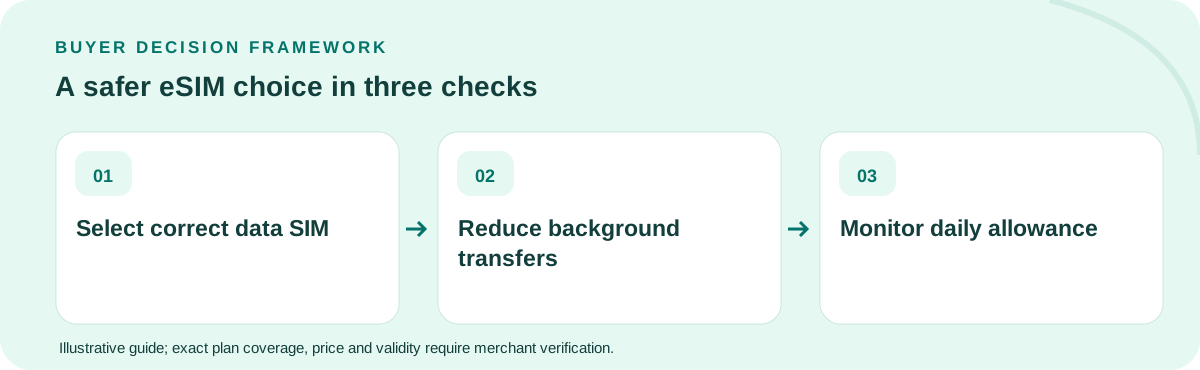
Low Data Mode can help limit some background network activity, but it is not an on/off switch for all mobile data. The strongest travel setup combines the correct data SIM, deliberate app settings, controlled photo backups and a clear emergency access plan.
Who is this for?
Imagine a family arriving in Paris with 5 GB for a week. The phones start restoring photos, checking app updates and synchronizing files. The perceived problem is that the eSIM plan “disappeared” quickly; the actual issue may be unplanned background activity rather than poor network performance.
How to compare the available choices
On the iPhone, verify which cellular line is selected for data and then review Low Data Mode for that line. Inspect per-app cellular usage rather than assuming the phone’s generic battery setting reduces data. Consider pausing large cloud uploads and using offline maps on Wi-Fi before travel.
What to do before departure or purchase
The right goal is to protect data without breaking essential tasks. Transport ticket apps, messenger notifications and ride-hailing may require network access. Test the device after changes and maintain a way to reverse a setting that interferes with an urgent travel need.
Worked example with explicit assumptions
Hypothetical example: a traveler budgets 700 MB per day for seven days, totaling 4.9 GB. A single unplanned 1.5 GB photo upload would consume nearly a third of that total. The calculation illustrates budget sensitivity, not a universal claim about iCloud traffic.
Common mistakes to avoid
Beware of confusing network quality with consumption. Reducing data usage does not improve radio coverage or create more GB in the purchased product. Also, keeping home-line data roaming enabled can produce charges outside the travel eSIM even when its bucket is carefully managed.
What would change the answer?
An effective test uses the same apps for one ordinary day before and after changing settings. Record total mobile data in the handset statistics and note whether Wi-Fi was used differently. This is not a laboratory experiment, but it is better than assuming a fixed percentage saving. Avoid disabling background access for safety-critical notifications or travel apps without testing that they still perform the needed function.
Five-item decision worksheet
| Check | What to verify |
|---|---|
| Eligibility | Confirm the exact device, activation method and covered destination(s) against the retail product, not a country-average study. |
| Validity | Work backward from the situation described in this guide: Imagine a family arriving in Paris with 5 GB for a week. Check when the clock starts and the last active day. |
| Usage | Estimate the full-speed GB or communication capabilities this particular itinerary needs; include hotspots, essential apps and an emergency buffer. |
| Economics | Compare current final payable totals only among options that meet every requirement; treat any arithmetic example here as hypothetical. |
| Fallback | Before departure, consider this failure mode: Beware of confusing network quality with consumption. Keep the seller’s support instructions available offline. |
Which option should you buy?
Use the built-in cellular statistics for a few days before travel, set sensible limits and confirm the travel line for data. Then choose a verified allowance that accommodates actual behaviors rather than assuming a low-data setting makes an undersized plan sufficient.
Will Low Data Mode make a 1 GB eSIM last the whole holiday?
There is no guarantee. Usage depends on apps and activities; monitor actual consumption, limit background transfers and retain a reserve for essential tasks.
Primary technical/regulatory reference: official guidance for this topic. This source provides background, not a verification of any live TripoSIM SKU. The scenarios, prices and quantities in this guide are illustrations, not tested carrier offers. Every product's eligibility, data, voice, coverage, activation, fair use and current final price must be checked with the seller before purchase.
Ownership: This website is commercially affiliated with TripoSIM. It does not claim independent testing, neutrality or live catalog pricing. See research methodology.