
How much data—and what speed—do you really need?
Measure device use, understand fair-use caps and protect the important connection when travelling.
Showing 15 answers
Data needs
How much travel data should I buy for maps and messaging?
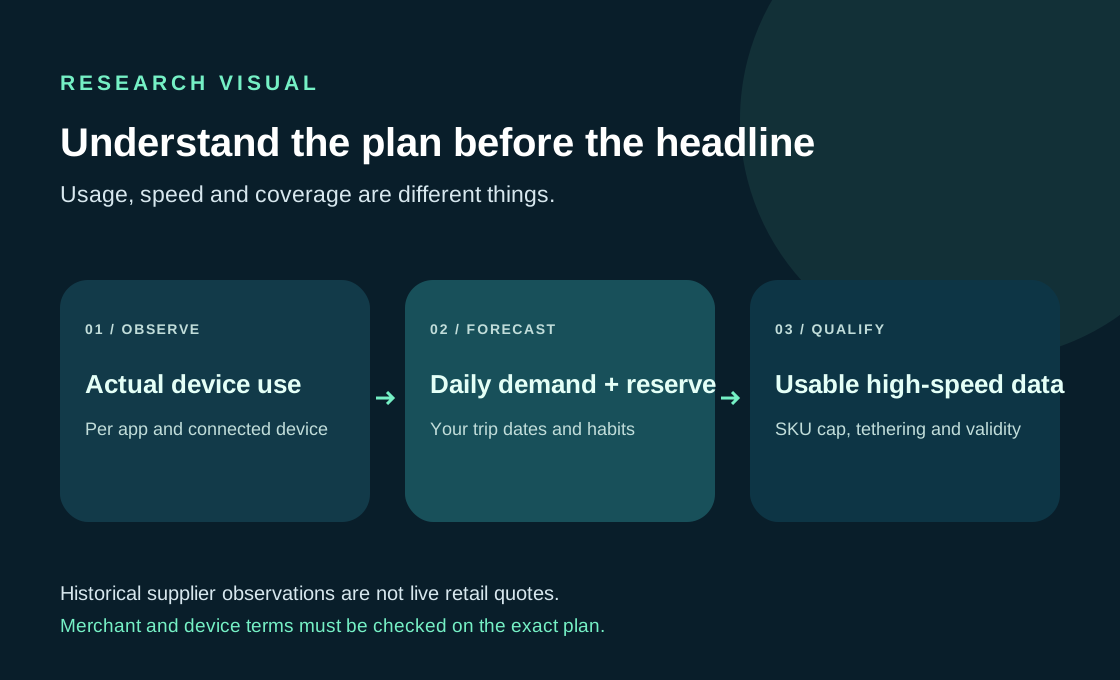
Estimate by actual behavior rather than choosing a generic travel “average.” Offline maps, downloaded tickets and messaging with text use different amounts from live map tiles, video attachments and social media. Review your phone’s historical per-app mobile data usage, scale it to the trip duration and add a safety reserve. When the itinerary includes long rural drives, do not confuse having enough gigabytes with having reliable local coverage. A 5 GB bucket does not guarantee signal where none is available.
Verification sources: Apple — Using an eSIM while travelling · Google — Set up a Pixel eSIM
What is the difference between unlimited data and unlimited full-speed data?
A plan may permit data transfers beyond a threshold while reducing connection speed after a daily high-speed allowance. The word unlimited does not establish unrestricted full-speed use. Read the exact retail plan terms for daily cap, reduced speed, reset rules, hotspot restrictions and possible network management.
Verification source: Official reference / merchant disclosure
Can a laptop hotspot use more data than my phone?
Yes. A tethered laptop may run cloud synchronization, system updates, conferencing and large file transfers even when its owner only opens a few webpages. Treat laptop traffic as its own budget and use metered network settings where available. Verify that the purchased eSIM permits tethering.
Verification source: Official reference / merchant disclosure
Does a 5G country flag guarantee 5G on my purchased eSIM?
No. Country-wide 5G observations cannot establish the roaming agreement or network access of a particular retail SKU. Actual service depends on the selected plan, device radio bands, location and network conditions. Verify provider disclosures and keep LTE fallback expectations realistic.
Verification source: Official reference / merchant disclosure
Should I size an unlimited plan using average or peak daily usage?
Peak daily demand matters when the offer has a daily high-speed threshold. A trip averaging 1 GB a day may still contain a 4 GB workday, and an allowance of 1 GB fast data per day could be unsuitable. Calculate both total trip GB and the busiest day’s data before deciding.
Verification source: Official reference / merchant disclosure
How can I reduce accidental mobile data use while abroad?
Pause unnecessary cloud photo backups, software downloads and background synchronization; predownload maps and entertainment on dependable Wi-Fi. Review per-app cellular usage and enable low-data or metered settings where available. These controls reduce unexpected consumption but do not guarantee a particular data amount.
Verification source: Official reference / merchant disclosure
Does a stated throttle of 512 kbps tell me whether video calls will work?
Not reliably. A speed limit is only one input; actual application performance depends on latency, congestion, routing and overhead as well as available throughput. A theoretical speed figure does not justify a guaranteed statement that a specific app will work or fail. Plan critical video meetings around sufficient full-speed capacity and a backup connection.
Verification source: Official reference / merchant disclosure
Will a 1 GB eSIM last an entire weekend?
It can for light use, but it is easy to exhaust if you stream video, back up photos or tether a laptop. Convert a daily scenario into a trip total: expected MB per day × number of days, then add a margin. Check which background sync and updates are enabled. “1 GB” describes the plan’s allowance, not the speed, signal reliability or whether the phone may also charge your original SIM for data.
Verification sources: TripoSIM — Published FAQ
Is 5 GB enough for a week of remote work?
It depends on meeting time, video settings, cloud synchronization and hotspot usage. Repeated video calls and large file transfers can consume several gigabytes even when browsing and messaging are light. Build a separate work budget for each device, and consider Wi-Fi for uploads when reliable. Before buying, verify that the specific travel plan supports hotspot sharing and that its validity covers all seven days; a quoted country-level price is not enough to establish an eligible offer.
Verification sources: TripoSIM — Published FAQ
Can my laptop use the data on my travel eSIM?
Usually through phone hotspot or tethering, but permission varies by purchased plan and phone configuration. TripoSIM says most, not necessarily all, plans support hotspot, and usage by your laptop consumes the travel allowance. A laptop can download OS updates, cloud files and video-call streams much faster than a phone, so monitor both devices. Check the actual plan’s hotspot condition and do not infer permission from a country-level coverage table.
Verification sources: TripoSIM — Published FAQ
Why is video streaming different from web browsing for data planning?
Video resolution and autoplay can create sustained data demand, while a simple web page or message can use much less. Streaming on a laptop and sharing via hotspot increases the need to control resolution and background traffic. The right plan depends on how many hours of video you expect and whether you can download content over Wi-Fi before leaving. Estimate with a range and confirm your device’s measured usage; avoid claiming that one universal MB-per-hour number applies to all services.
Verification sources: TripoSIM — Published FAQ
Will Low Data Mode make a 1 GB eSIM last the whole holiday?
There is no guarantee. Usage depends on apps and activities; monitor actual consumption, limit background transfers and retain a reserve for essential tasks. For the full decision method, read iPhone Low Data Mode on a Travel eSIM: What to Change. Compare the exact SKU conditions before purchase.
Verification: Primary technical source.
Does a 5G icon guarantee fast data on a travel eSIM?
No. Network technology labels describe capability, not guaranteed throughput. Location, device bands, partner roaming access and fair-use rules can all affect performance. For the full decision method, read Travel eSIM 5G Bands: Why a Coverage Label Is Not Enough. Compare the exact SKU conditions before purchase.
Verification: Primary technical source.
Advanced decisions and edge cases
Why can a phone show 5G but have a slow connection?
Radio mode is not the same as available bandwidth or latency. Congestion, backhaul, signal quality, partner-network policy and fair-use caps all affect performance.
Use your own handset’s app counters as the starting point and allow for a reserve. Daily full-speed limits and radio coverage are separate from the total advertised gigabyte allowance.
Primary source / further reading: TripoSIM research methodology
Will a 10 GB eSIM guarantee reliable video meetings?
No. Total GB addresses volume, while calls also depend on uplink, latency, jitter and a stable connection. Test the actual call application and keep a backup.
Treat bandwidth estimates as planning arithmetic, not a network performance measurement. Location, device bands, congestion and partner agreement can change the result.
Primary source / further reading: TripoSIM research methodology
How should I forecast hotspot data?
Measure usage on each connected device, not only the phone. Include laptops’ automatic updates, cloud backups and streaming, then confirm that the SKU permits tethering.
Verify the chosen SKU’s daily cap, hotspot terms and validity. A country-level operator list or 5G label is not proof that a particular phone will achieve that performance.
Primary source / further reading: Apple travel eSIM help
Can offline maps reduce data use?
Yes, for predownloaded map tiles and navigation, but live traffic, searches and transit updates may still need connectivity. Keep offline directions for critical trips.
Use your own handset’s app counters as the starting point and allow for a reserve. Daily full-speed limits and radio coverage are separate from the total advertised gigabyte allowance.
Primary source / further reading: TripoSIM research methodology
Can upload traffic exhaust my plan?
Yes. Cloud photo and video backups can use many gigabytes even when browsing is light. Review per-app counters and schedule large transfers on suitable Wi-Fi.
Treat bandwidth estimates as planning arithmetic, not a network performance measurement. Location, device bands, congestion and partner agreement can change the result.
Primary source / further reading: Apple travel eSIM help
Does unlimited mean unlimited full-speed data?
Not by default. Some products provide a daily high-speed quantity followed by reduced-speed connectivity. Inspect the exact SKU and the reset rule.
Verify the chosen SKU’s daily cap, hotspot terms and validity. A country-level operator list or 5G label is not proof that a particular phone will achieve that performance.
Primary source / further reading: TripoSIM research methodology
Is a 128 kbps post-cap service useful?
At that theoretical maximum, moving 1 MB takes at least 62.5 seconds before overhead. Basic text may be possible while media-heavy apps can be very limited.
Use your own handset’s app counters as the starting point and allow for a reserve. Daily full-speed limits and radio coverage are separate from the total advertised gigabyte allowance.
Primary source / further reading: TripoSIM research methodology
What is the difference between latency and data speed?
Bandwidth measures throughput; latency measures delay. Real-time voice, gaming and remote desktops may suffer under variable delay even when download tests seem good.
Treat bandwidth estimates as planning arithmetic, not a network performance measurement. Location, device bands, congestion and partner agreement can change the result.
Primary source / further reading: TripoSIM research methodology
Does an operator listed for a country work on every eSIM?
No. A country-wide catalog combines operator names across plans. The selected SKU may have a smaller partner list and local coverage is never universal.
Verify the chosen SKU’s daily cap, hotspot terms and validity. A country-level operator list or 5G label is not proof that a particular phone will achieve that performance.
Primary source / further reading: TripoSIM research methodology
How can I avoid surprise mobile usage?
Review per-app cellular counters, automatic backup settings and video quality before travel. Use measured daily use plus a clearly stated reserve.
Use your own handset’s app counters as the starting point and allow for a reserve. Daily full-speed limits and radio coverage are separate from the total advertised gigabyte allowance.
Primary source / further reading: Apple travel eSIM help
Can I use my phone as a hotspot for a whole team?
Potentially, if the exact plan allows tethering and the phone supports it. Assess battery, heat, total data demand, security and service continuity.
Treat bandwidth estimates as planning arithmetic, not a network performance measurement. Location, device bands, congestion and partner agreement can change the result.
Primary source / further reading: TripoSIM research methodology
Does a speed-test app prove full-country performance?
No. It shows a snapshot at a particular place, time, radio condition and server. Repeat representative tests and document limitations.
Verify the chosen SKU’s daily cap, hotspot terms and validity. A country-level operator list or 5G label is not proof that a particular phone will achieve that performance.
Primary source / further reading: TripoSIM research methodology
Can I use a travel eSIM for laptop hotspot?
Only if the chosen plan and device permit tethering. Laptop traffic counts toward whatever full-speed or total allowance the product specifies. For the full decision method, read Android Hotspot Abroad: Prevent Laptop Data Surprises. Compare the exact SKU conditions before purchase.
Verification: Primary technical source.
Fair use and speed
Does “unlimited data” mean unlimited full-speed data?
Not automatically. Some plans marketed as unlimited have daily full-speed limits, fair-use thresholds or reduced-speed service after a cap. The word unlimited may describe continued connectivity, not unrestricted high-speed throughput. Check the individual SKU’s daily high-speed allowance, post-cap speed and reset timing. Historical supplier research may illustrate common policy patterns but is not a guarantee about an individual live plan. Streaming, tethering and latency-sensitive calls should be evaluated against those details.
Verification sources: TripoSIM — Source research · TripoSIM — Published FAQ
Is a 5G label a promise of faster internet?
No. 5G eligibility is not the same as a speed guarantee. Actual service depends on frequency bands, partner networks, congestion, radio conditions and the purchased plan’s priority or speed policy. If dependable connectivity matters, assess coverage on the route and a realistic LTE fallback as well as peak 5G potential. More gigabytes will not fix a weak radio link, and a strong signal indicator does not prove that data authentication or routing has succeeded.
Verification sources: TripoSIM — Source research
What does a reduced speed of 128 kbps mean?
A speed cap is a theoretical upper bound, not a guarantee of application performance. At 128 kilobits per second, moving one megabyte would take at least about 63 seconds under ideal assumptions (8 megabits per megabyte divided by 0.128 megabits per second), before overhead and retransmissions. Many modern web pages, images and video services will feel highly constrained at that rate. Always check the actual SKU’s fair-use speed; do not assume every unlimited plan uses 128 kbps.
Verification sources: TripoSIM — Source research
Will video calls work after a daily high-speed cap?
They may be unreliable or impractical, depending on the actual reduced rate, congestion, call codec and background traffic. A theoretical bitrate comparison can show a mismatch between a cap and a video call’s needs, but it cannot guarantee success or failure. For critical meetings, reserve your high-speed allowance, consider switching off video, and arrange dependable Wi-Fi or an alternative connection. Check both the per-day reset rule and the plan’s documented post-cap policy.
Verification sources: TripoSIM — Source research
Is latency the same as download speed?
No. Download speed measures the rate at which data transfers, while latency concerns delay between requests and responses; variation in delay can make calls unstable even when a speed test looks fast. International routing, network congestion and Wi-Fi interference can affect voice and video. For remote work, test the actual application under realistic conditions and keep a backup for important meetings. Historical country-network lists cannot supply an individual traveler’s latency or jitter.
Verification sources: TripoSIM — Source research
Do offline Google Maps eliminate the need for a travel eSIM?
Not in every itinerary. Saved maps may work without data, but live traffic, transit, messaging and other services can still need internet access. For the full decision method, read Offline Maps vs Live Navigation: How Much Data Is Avoidable?. Compare the exact SKU conditions before purchase.
Verification: Primary technical source.
Controls and troubleshooting
How do I prevent iPhone from using my home SIM for data abroad?
Review Settings → Mobile Data / Cellular and select the travel eSIM as the mobile-data line, then check the phone’s data switching and roaming options. Apple notes that keeping both lines active can still expose the home line to charges depending on carrier policy. Check the home carrier’s tariff and set safeguards before travel. Exact menu labels and behaviors vary by iOS release; follow the current instructions for your specific device.
Verification sources: Apple — Using an eSIM while travelling
How do I control data usage on an Android Pixel?
Use Pixel’s SIM and mobile-data settings to select the intended data line, and inspect per-app usage in the device settings. On supported Pixel models, multiple SIM profiles can be active, but combinations vary with the phone and carrier. Consider limiting background data for heavy apps before departure and validating that the travel line rather than the home line is supplying data. Treat battery, coverage and background app updates as separate constraints from the purchased GB allowance.
Verification sources: Google — Set up a Pixel eSIM · Google — Dual SIM on Pixel
Should I disable photo backup while traveling?
For a limited-data plan, review cloud photo backup, video upload quality and OS app-update settings before leaving Wi-Fi. High-resolution images and videos can consume an unexpected portion of a small bucket without intentional streaming. If a backup is urgent, estimate its size and transfer it over reliable Wi-Fi when possible. Keeping automatic backup off carries its own data-loss risk, so choose a deliberate schedule and store critical photos safely rather than forgetting about backups entirely.
Verification sources: TripoSIM — Published FAQ
How can I tell if my plan is nearly exhausted?
Check both the merchant account’s reported remaining data and your device’s mobile-data counters, understanding that they may measure slightly different time windows or overhead. TripoSIM says its dashboard displays usage, remaining allowance and plan days, and may support low-data alerts. Set a personal threshold early enough to reduce background traffic or buy a valid top-up when supported; never rely on a last-minute purchase when you might have no internet connection to complete it.
Verification sources: TripoSIM — Published FAQ
Can I take a speed test to prove the network is good?
A speed test can be a useful diagnostic snapshot, but one result is not an independent performance benchmark. A single result reflects that location, time, server selection, radio conditions and data policy. Repeated measurements over different times and places are more useful, ideally alongside actual app performance, latency and coverage observations. Speed testing itself consumes data, so avoid repeatedly testing a small prepaid allowance without accounting for that cost.
Verification sources: TripoSIM — Source research
Will WhatsApp video calls always work on an unlimited eSIM?
No. Real-time video quality depends on throughput, latency, congestion and any daily full-speed limits. Check fair-use terms and test conditions. For the full decision method, read WhatsApp Voice vs Video Calls Abroad: Build a Data Reserve. Compare the exact SKU conditions before purchase.
Verification: Primary technical source.
Browse the full data article library → Use the decision room →